7 Best Ad Creation Tools for Images and Video in 2026
Discover the best tools to create video or image ads. Learn what is the best ad creation software on the market today.

Initially published August 5, 2025 · Last updated February 27, 2026 — Revised tool selection, updated 2026 pricing, and restructured around a clearer taxonomy of AI video use cases.
"AI video tool" meant one thing in 2023. In 2026 it covers three completely different categories of software solving completely different problems, and most comparison guides still treat them as interchangeable.
This guide separates them clearly. Four tools for editing footage you already have, four for generating video from scratch, and one for automating video production at scale. Each is reviewed on what it actually does well, with honest limitations and real 2026 pricing.
If you already know which category you need, jump straight to the comparison table. If you're not sure, the section below will take you 90 seconds to read and will save you weeks of wrong-fit trials.
Before evaluating individual tools, it's worth being precise about what category you actually need. Because choosing the wrong type of tool wastes more time than choosing the wrong tool within the right category.
AI Video Editors help you work faster on footage you already have. Cutting, subtitling, noise removal, transcript-based editing. You direct the creative; the AI eliminates the manual work.
Generative AI Video creates video from a text prompt, script, or image, without requiring source footage. Quality and controllability vary significantly between platforms, and the gap between the best and worst tools widened considerably in 2026.
Video Automation produces many versions of the same video automatically. Different products, languages, offers, or markets... from a single master template. This is production infrastructure, not a creative tool, and it solves a completely different problem from the other two categories.
Most professional marketing teams use at least two categories. A common stack: an editor for social content → a generative tool for original creative → an automation platform when a campaign needs to scale across dozens of variants.
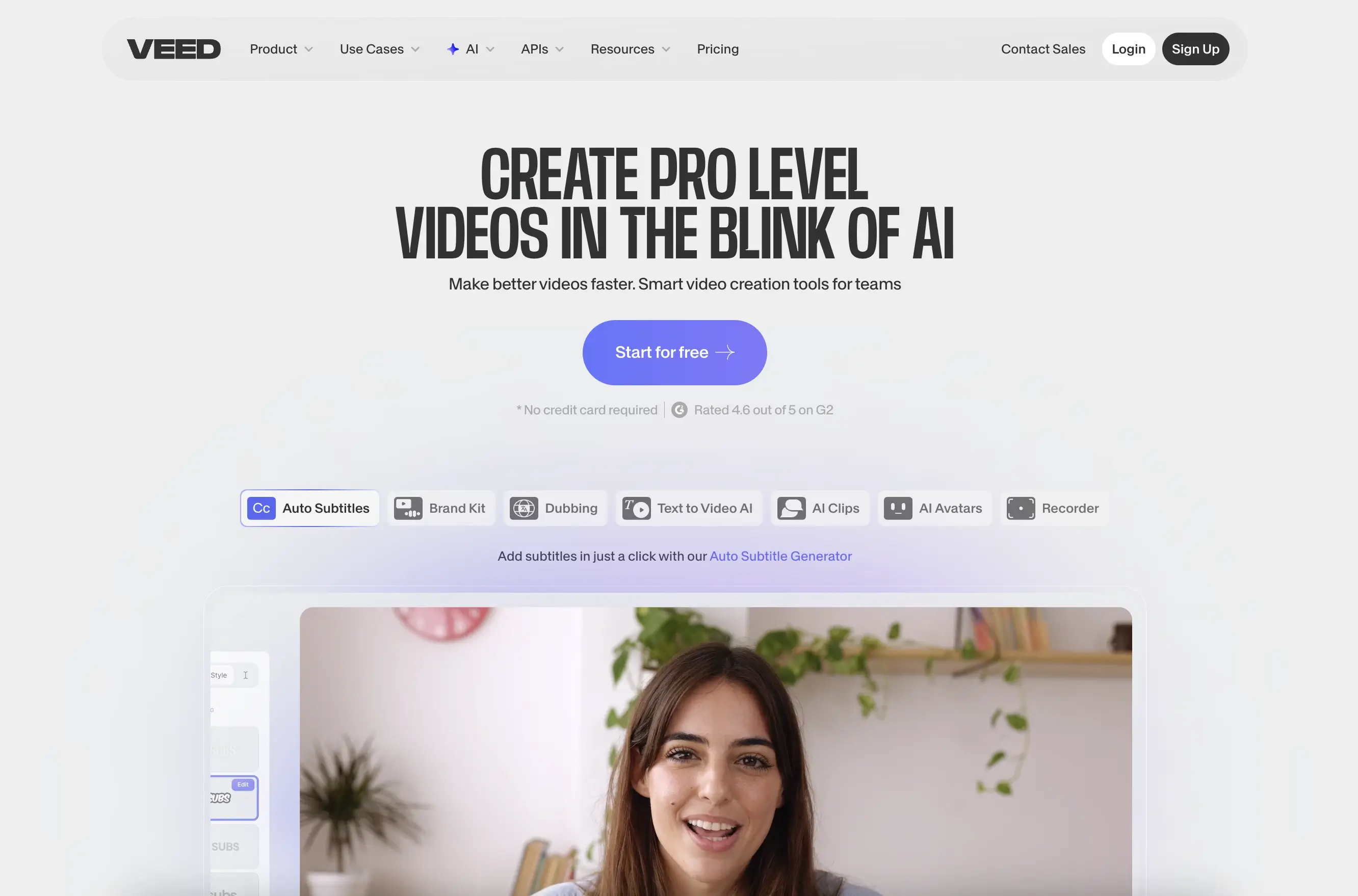
VEED is the benchmark for browser-based AI video editing. No software to install, no complex interface to learn. For marketing teams producing regular social content, that frictionlessness is the core value. You open a tab and start editing.
The AI subtitle engine is best-in-class: fast, accurate, and fully customizable in style and timing. Beyond subtitles, VEED handles background removal, auto-translation into 100+ languages, brand kit management, and a script-to-video workflow that covers most social content needs without requiring additional tools.
Best for: Social media managers, content creators, and marketing teams producing short-form video for TikTok, YouTube, Instagram, and LinkedIn.
Key features:
Limitations:
Pricing: Free plan available with limited exports. Pro from $25/month.
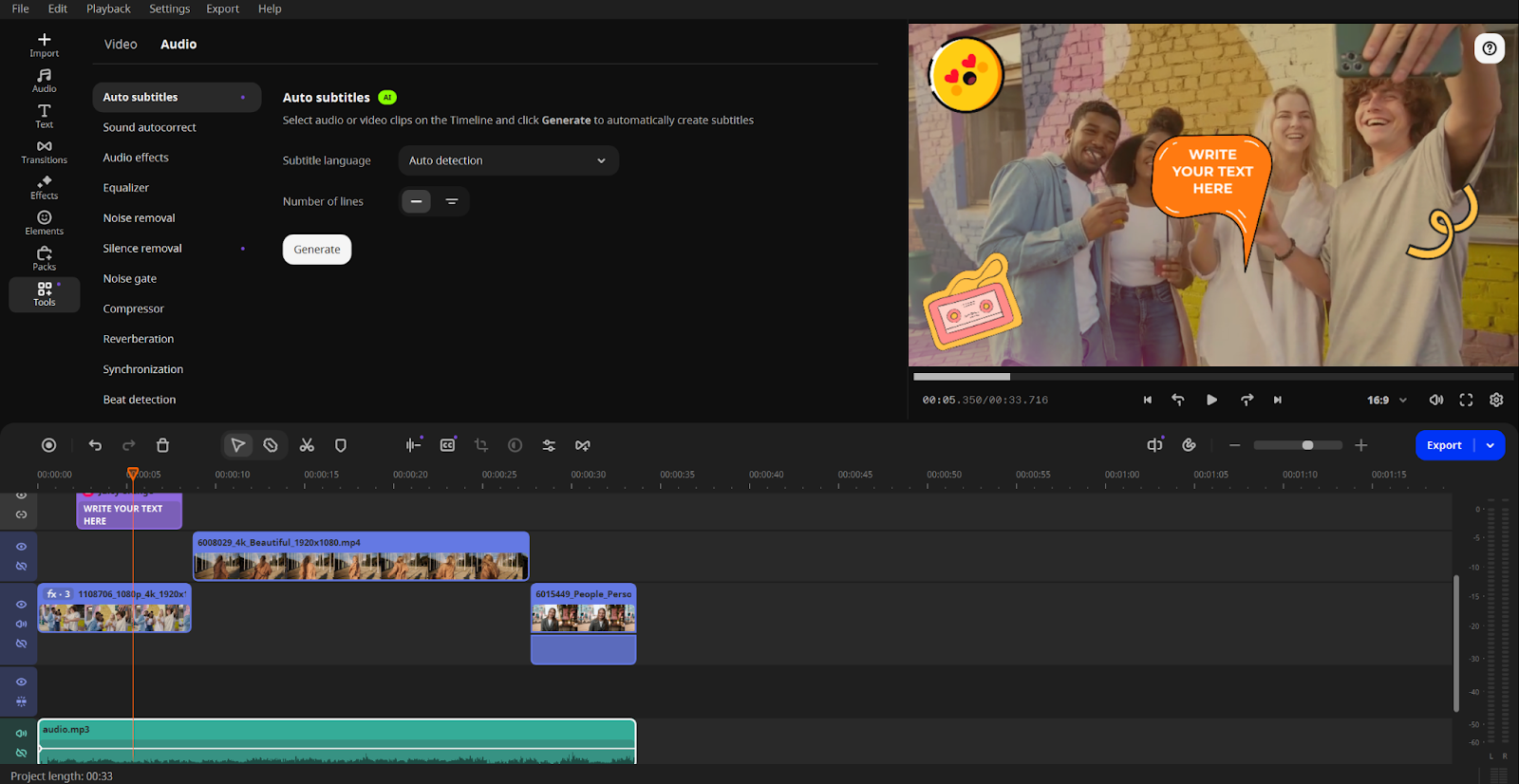
Movavi Video Editor is the strongest desktop option for marketers and educators who want reliable AI-assisted editing without a steep learning curve. Available on Windows and Mac, it delivers a classic timeline experience with practical AI layered in. Not experimental features, just things that actually work consistently.
Silence detection, motion tracking, background removal, AI subtitles: every feature does what it says on the first try, without requiring prompt engineering or technical configuration. For solo creators and small teams who want desktop stability and predictability over browser-based flexibility, Movavi is the right trade-off.
Best for: Marketers, educators, and solo creators producing tutorials, product demos, reels, and talking-head content who prefer desktop reliability over cloud-based tools.
Key features:
Limitations:
Pricing: Free trial available. Paid plans from $19.95/month or $59.95/year.

Descript reframes video editing entirely: you edit the transcript, and the video updates to match. Delete a sentence, that footage disappears. Correct a word in the text, the AI regenerates the spoken audio with your voice. For anyone producing interview content, podcasts, tutorials, or dialogue-heavy video, this approach cuts editing time more than any other innovation in the category.
Best for: Podcast producers, interview editors, course creators, and teams whose video output is primarily spoken word.
Key features:
Limitations:
Pricing: Free plan available. Creator from $19/month.

Filmora is the cross-platform option for creators who want a traditional timeline editing experience with AI enhancements available on every device they work from. Windows, Mac, iOS, Android. cConsistent performance across the board, which is rare in this category.
The AI features won't surprise anyone coming from browser-based tools, but they're solid: color correction, background removal, audio enhancement, and motion effects. The primary advantage is the familiar interface for users who already think in traditional editing terms and want to add AI features without switching paradigms.
Best for: Content creators who need traditional editing with AI enhancements and work across multiple devices.
Key features:
Limitations:
Pricing: Free (watermarked). Annual plan from $59.99/year.
Google Veo is the best all-around generative video model available in 2026 for most use cases. According to independent testing by Zapier and others who have benchmarked the major models, Veo produces the most consistently photorealistic output across diverse prompts. Handling motion, lighting, and physical coherence better than any competing model.
It's accessible through Google AI Studio and Gemini, which makes it straightforward for teams already in the Google ecosystem. The main limitation is less granular creative control compared to Runway for professionals who need precise direction.
Best for: Marketing teams needing high-quality generative video for campaigns, product visualization, and branded content without deep technical expertise.
Key features:
Limitations:
Pricing: Available via Google AI Studio. Currently accessible with Google One AI Premium and select enterprise plans.

Runway remains the professional standard for generative video when creative precision matters. Gen-4 introduced meaningful improvements to character consistency (one of the category's longstanding weaknesses). Making it substantially more useful for branded content where the same visual elements need to appear reliably across multiple clips.
The trade-off is the learning curve. Getting consistently usable output from Runway requires investing time in understanding how the model responds to different prompt structures and reference inputs. It rewards that investment with capabilities no other tool matches for controlled, cinematic output.
Best for: Creative directors, brand filmmakers, and marketing teams producing hero creative, mood reels, and high-production-value visual content where quality is the primary constraint.
Key features:
Limitations:
Pricing: Free (limited credits). Standard from $15/month.
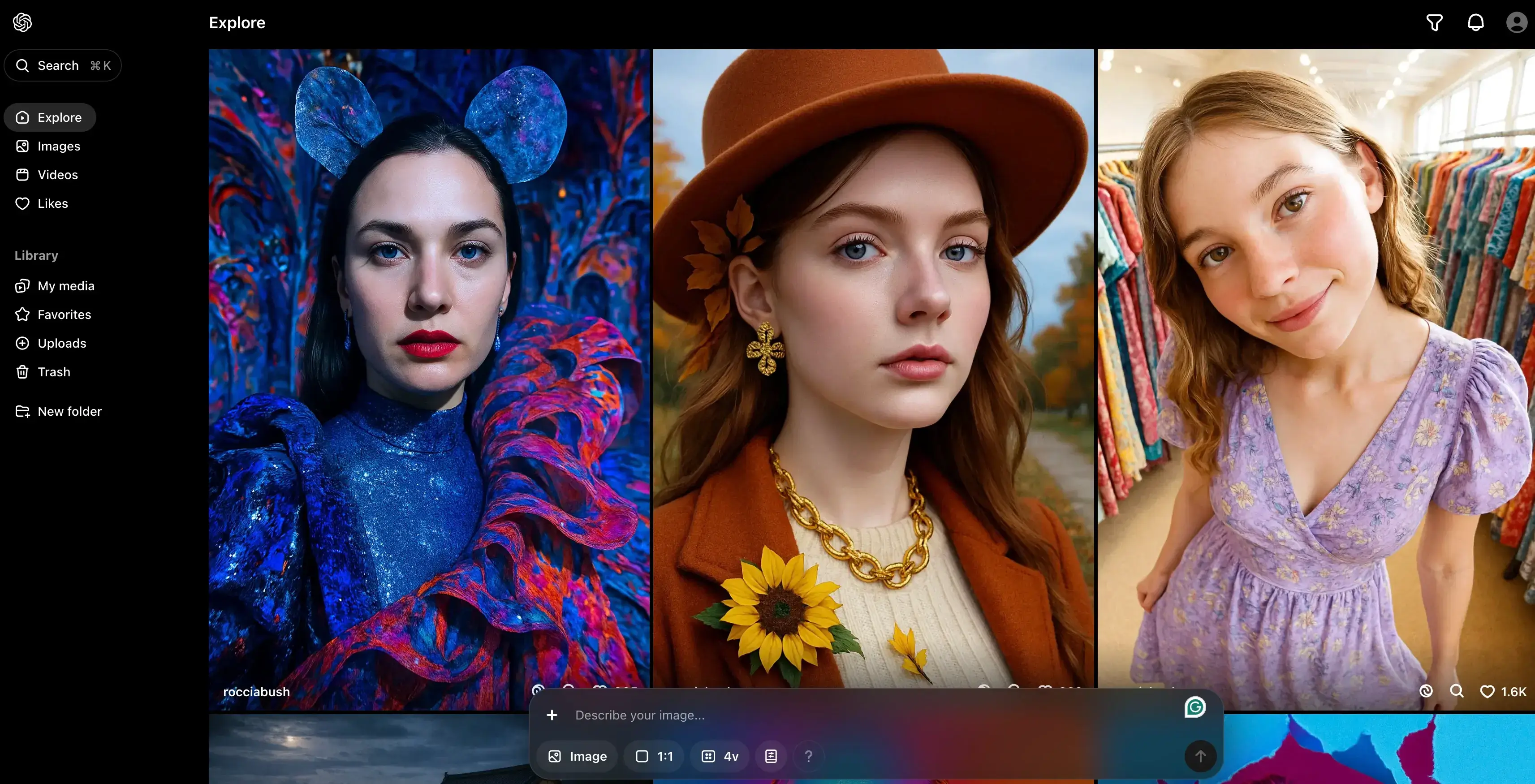
Sora, built by OpenAI, produces high-quality generative video from straightforward text prompts with better out-of-the-box results than most alternatives for users who don't want to invest time in prompt engineering. The camera movement simulation is particularly impressive for atmospheric and conceptual content.
It's the right choice when you need quality output quickly without a learning curve. It's the wrong choice when you need precise creative control over specific visual elements (Runway handles that better).
Best for: Marketing teams needing original visual content fast, without dedicating time to prompt engineering. Brand mood films, B-roll, conceptual content.
Key features:
Limitations:
Pricing: From $20/month via ChatGPT Plus. ChatGPT Pro ($200/month) for extended access and higher resolution.
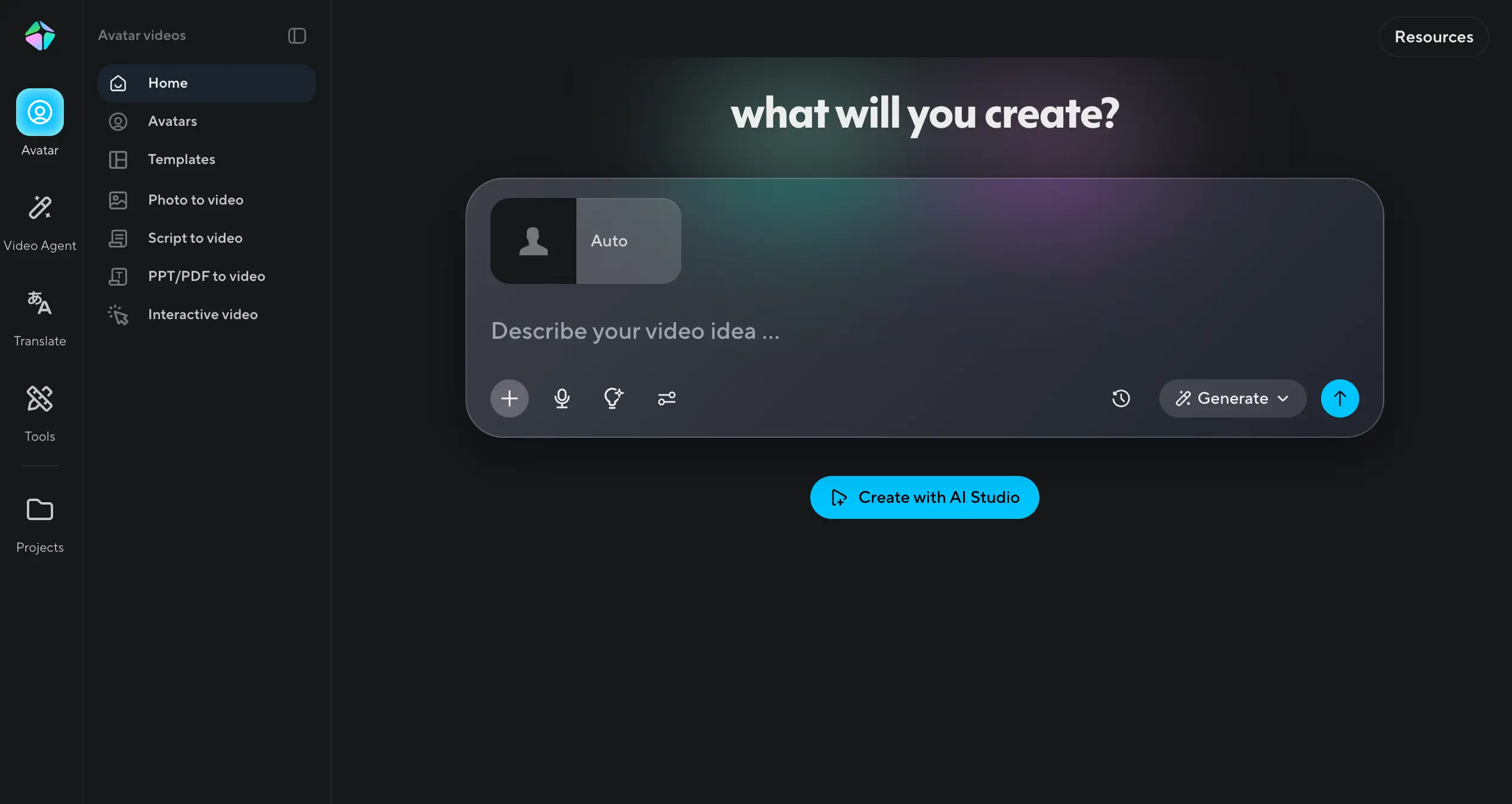
HeyGen has become the dominant platform for AI avatar video in 2026, particularly for teams that need personalization and multilingual production at scale. What distinguishes it from Synthesia is the combination of realistic avatar quality, real-time interactive avatars for sales and customer-facing use cases, and a strong API that integrates into broader content workflows.
The ability to create a custom avatar from a short video recording, then generate personalized video messages in multiple languages with accurate lip-sync, is the capability that makes HeyGen genuinely useful for sales teams and global marketing programs, not just a demo feature.
Best for: Sales teams, global marketing programs, corporate training, and any use case requiring personalized or multilingual video at volume.
Key features:
Limitations:
Pricing: Free (limited credits). Essential from $29/month. Scale plans for teams.

Abyssale occupies a different category from every other tool on this list. It doesn't edit footage, and it doesn't generate video from a prompt. It automates the production of many versions of the same video from a single master template, and that distinction matters.
The workflow is specific: you design one on-brand video template in Abyssale's editor. You connect a spreadsheet, no-code integrations, or API with your variable data. Different product names, prices, video footages, images, store locations, or language variants. Abyssale generates every version automatically, exports in every format you need, and keeps every output inside your brand guidelines.
This is how e-commerce teams run product video campaigns without one video per SKU becoming a production bottleneck. How retail chains push localized content to hundreds of locations simultaneously. How agencies deliver 50 campaign variants per client without 50× the production time.
Best for: Marketing teams, e-commerce brands, multi-location retailers, and agencies with recurring, structured, high-volume video production needs.
Key features:
Limitations:
Pricing: Free trial available. Paid plans from $15/month.
The right answer depends entirely on what problem you're solving:
You have footage and need to edit it faster → VEED.IO for browser-based speed and subtitles, Movavi for desktop reliability, Descript if most of your content is spoken word
You need to generate original video from nothing → Google Veo for best all-around quality, Runway for professional creative precision, Sora if you want quality output without a learning curve
You need AI avatar video → HeyGen for personalization and multilingual production at scale
You need to produce the same video in many versions automatically → Abyssale
Most professional marketing teams don't pick one tool across the board. They pick the right tool for each part of their production workflow, and build a stack that handles editing, generation, and automation as separate functions.
Output format flexibility.
Every platform you distribute to has specific format requirements. Aspect ratios, file types, resolution, maximum file size. Verify these before signing up, not after.
Collaboration and review workflow.
If more than one person reviews video before it goes live, you need version control, comments, and approval flows built into the tool. Not a shared folder.
Pricing model vs. your actual usage pattern.
Per-seat pricing penalizes high-volume teams. Per-credit or per-render pricing penalizes frequent, smaller productions. Match the model to how you actually work before the bill arrives.
Integration with your content stack.
The best tools connect directly to where your source data lives. Spreadsheets, DAMs, CMSs, ad platforms. Native Zapier or Make compatibility is a baseline requirement for any team doing volume work.
Rendering speed at real production volumes.
A tool that takes 10 minutes per render is not a tool you can use to produce 200 variants on a deadline. Test with real volumes before committing.
What is the difference between an AI video editor and an AI video generator?
An AI video editor helps you work faster with footage you already have. Cutting, captioning, cleaning up audio. An AI video generator creates new video from a text prompt or script without requiring source footage. They solve different problems. Most teams need both.
Which AI video tool is best for marketing teams in 2026?
It depends on your primary constraint. For editing social content fast: VEED.IO. For generating original brand video: Google Veo or Runway. For avatar video at scale: HeyGen. For producing high volumes of variants across products or markets: Abyssale. Teams with diverse needs typically combine two or three.
Can AI video tools fully replace a video editor?
For templated, high-volume, recurring production,... largely yes. For complex one-off productions where artistic judgment drives every decision, no. The best use of AI video tools is removing the repetitive work so editors can focus on the creative decisions that actually require human judgment.
What is the best free AI video tool in 2026?
VEED.IO and Descript both have genuinely usable free tiers for editing. Runway offers free credits sufficient to evaluate generation quality. Google Veo is accessible via free tiers in Google AI Studio. Most free plans impose watermarks or export caps. Test on representative content before upgrading.
How does Abyssale differ from Runway or VEED.IO?They operate in entirely different categories. Runway generates new video from prompts. VEED.IO edits existing footage. Abyssale takes a template you've already created and produces it at scale across every variation you need. Different tools for different stages of a video marketing workflow... many teams use all three.
AI video in 2026 is not one market. It's three → editing, generation, and automation. The most common mistake is evaluating tools from different categories against each other and wondering why the "winner" doesn't quite fit the workflow.
If you're editing footage, VEED.IO and Movavi lead on ease and reliability. If you need original video generated from a prompt, Google Veo and Runway set the quality standard. If you need AI avatar video at scale, HeyGen is the benchmark. And if your problem is producing the same creative in many versions, across products, markets, languages, or formats. That's a production automation problem, and Abyssale is built specifically for it.
Get the category right first. The tool selection gets significantly easier from there.
Explore our guides and tutorials to unlock the full potential of Abyssale's spreadsheet feature for scaled content production.
.png)