

Send personalized images in Mailchimp emails
Hyper personalize your emailing campaigns using Mailchimp dynamic images! Add your merge tags to a simple dynamic image URL and let Abyssale do the rest.

You started your agency to create amazing work, not to become a factory manager.
Yet, as your agency grows, you likely find yourself stuck in a paradox: To make more money, you have to hire more people.
Your revenue grows linearly, but your overhead (salaries, software seats, office space, management time) grows exponentially. Your margins get squeezed. One lost client, and you are in the red.
This is the "Service Trap". It happens because you are selling Inputs (Hours) instead of Outputs (Assets).
In this guide, we will walk through the shift from a traditional Service Model to a Productized Automation Model. This isn't just about using new tools; it's about changing how you frame, price, and deliver value.
Let's look at the P&L of a typical "Q4 Campaign" request from a client: 50 banners, adapted for Meta, Display, and Pinterest.
Scenario A: The Manual Way (Hourly Billing)
Scenario B: The Automated Way (Value-Based Pricing)
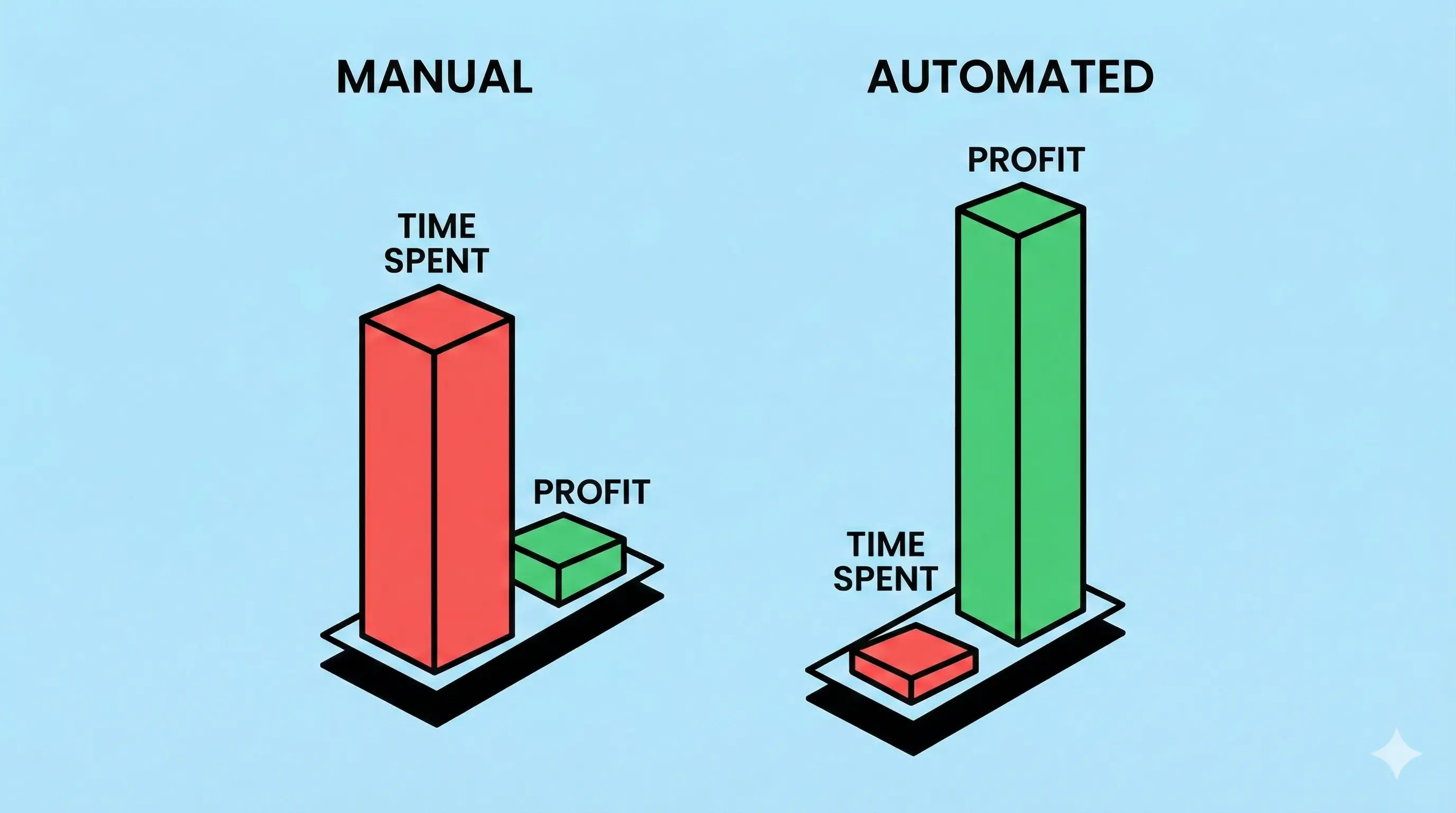
To achieve Scenario B, you need to stop treating every banner as a unique piece of art. Treat them as Data + Template.
Here is the tech stack of a scalable agency:
This is the hardest part for agency owners. "If I tell my client it took 5 minutes, they won't want to pay $1,800."
Wrong.
Clients do not pay for your effort. They pay for Speed, Consistency, and Performance.
The Pitch Script:
"Previously, a campaign rollout took us 4 days and cost $2,000. We are shifting to a new 'Creative Scale' technology.Now, we can deliver the same assets in 4 hours. Because we save time on manual resizing, we will include 2 extra A/B test variations for free to improve your ROAS. The price is fixed at $1,800."
You frame it as an upgrade (faster delivery + better performance), not a shortcut.
.webp)
The agencies that will dominate 2026 are those that productize their services. They will sell "Asset Packs" and "Scale Engines," not hours.
By adopting Creative Automation, you:
Stop pushing the boulder. Start piloting the rocket.
Want to see the numbers? Book a profitability audit with our agency experts and let's map out your automation stack.
Explore our guides and tutorials to unlock the full potential of Abyssale's spreadsheet feature for scaled content production.

.webp)

