8 Best AI Ad Generator Options for Your Campaigns in 2026
Discover the 8 best AI ad generators in 2026. Boost your marketing campaigns, save time, and create impactful ad creative with top ai tools.

Originally published on January 19, 2024. Updated on July 23, 2026 with a new platform selection, current pricing, and a workflow-based comparison.
Creative automation platforms share the same broad objective: reducing repetitive work when producing visual content at scale. The important differences are more practical... how content enters the system, which formats it produces, how much design control it preserves, how teams review and approve work, and whether publishing or media management is included.
A marketing team generating recurring campaign assets from approved designs and data does not have the same requirements as a display team producing HTML5 banners or a global advertiser connecting creative production with media operations. The comparison below focuses on those concrete differences.
Creative automation is the use of reusable designs, structured data, and software workflows to produce and adapt visual assets at scale. A designer defines the approved layout and rules; changing information such as product names, images, prices, languages, locations, or calls to action can then be used to generate controlled variations.
It differs from traditional design software because it automates repetitive production after the creative direction has been set. It also differs from generative AI, which primarily creates or edits source content, and from advertising platforms, which manage publishing, media buying, and campaign delivery. Some products combine these capabilities, so they should be compared by their generation methods, output formats, design controls, collaboration features, and activation scope. For a deeper explanation, read what creative automation is and how it works.
| Platform | Primary focus | Best fit when | Distinctive capabilities | Pricing model |
|---|---|---|---|---|
| Abyssale | Multi-output production from approved Designs and data | Teams need controlled assets through forms, spreadsheets, Dynamic Images, integrations, or an API | Several generation routes plus image, video, GIF, HTML5, and print outputs | Public plans from $45/seat/month; from $36 annually |
| Bannerflow | Creative management for digital advertising | Display production, feeds, publishing, live updates, and creative data need to share one ad workflow | Dynamic ads, publishing, scheduling, live updates, and creative reporting | Tailored quote for Grow, Pro, or Enterprise |
| Celtra | Enterprise modular advertising production | A global organization needs modular production connected to governance, activation, and insights | Modular creative, GenAI workflows, activation, and creative intelligence | Custom quote based on solution, scale, serving, and add-ons |
| Storyteq | Content adaptation and governance | Localization, review, asset management, and delivery matter as much as generating variations | Batch localization, approvals, delivery, and asset organization | Price on application; implementation fee plus annual license |
| The Brief | Editor-led AI ad creation | Teams want to create with prompts, templates, or an editor before automating variations | Prompt-to-design, editing, resizing, feed ads, and ad-serving features | Public plans from $29/month, billed annually |
| Viewst | HTML5 display-ad production | The main deliverable is an editable, animated banner set across many display sizes | HTML5-first production, smart resizing, animation, and ad-network exports | Public plans from $110/user/month, billed annually |
| Smartly | Creative automation connected to media | The organization wants production, trafficking, media management, and intelligence in the same system | Omnichannel creative, DCO, trafficking, media, and performance intelligence | No public rate card; request a demo |
Pricing checked on July 23, 2026. Public amounts are shown as published and use annual billing where stated. Quote-based pricing depends on scope, usage, services, or implementation.
Pricing checked on July 23, 2026. Public amounts are shown as published and use annual billing where stated. Quote-based pricing depends on scope, usage, services, or implementation.
Best fit when: approved Designs and structured inputs must become controlled assets without replacing the existing media, commerce, CRM, or content stack
Abyssale turns reusable designs and structured inputs into campaign variations across digital, animated, HTML5, and print-ready formats. Designers define the visual system; marketers, clients, operations teams, integrations, or applications can then generate approved assets without rebuilding the layout.
The platform supports several production routes for different levels of technical maturity. Teams can use Quick Generation forms for controlled self-service, spreadsheet generation for planned batches, Dynamic Image URLs for personalized images, a REST API for programmatic production, or no-code integrations with tools such as Zapier, Make, Airtable, and n8n.
Abyssale also combines structured automation with AI-assisted production. Its AI tools cover text-to-image generation, background generation and removal, generative fill, translation, autofocus, and format adaptation. Users can access multiple image-generation models inside the same workflow, then place the resulting visuals into controlled, reusable designs.
What makes it different: Abyssale keeps the production layer independent from campaign distribution. The same approved Design can be operationalized through a form, spreadsheet, dynamic URL, integration, or API and used to produce several output families instead of being tied to one advertising channel.
Primary scope:
Pricing: Pro costs $45/seat/month and Suite $75 on monthly billing. Annual equivalents are $36 and $60 per seat/month. Enterprise pricing is custom. A 14-day trial is available without a credit card. See Abyssale pricing.
Selection signal: shortlist Abyssale when the bottleneck is producing many controlled assets from repeatable Designs and data while keeping the tools already used for media, commerce, CRM, or content delivery.
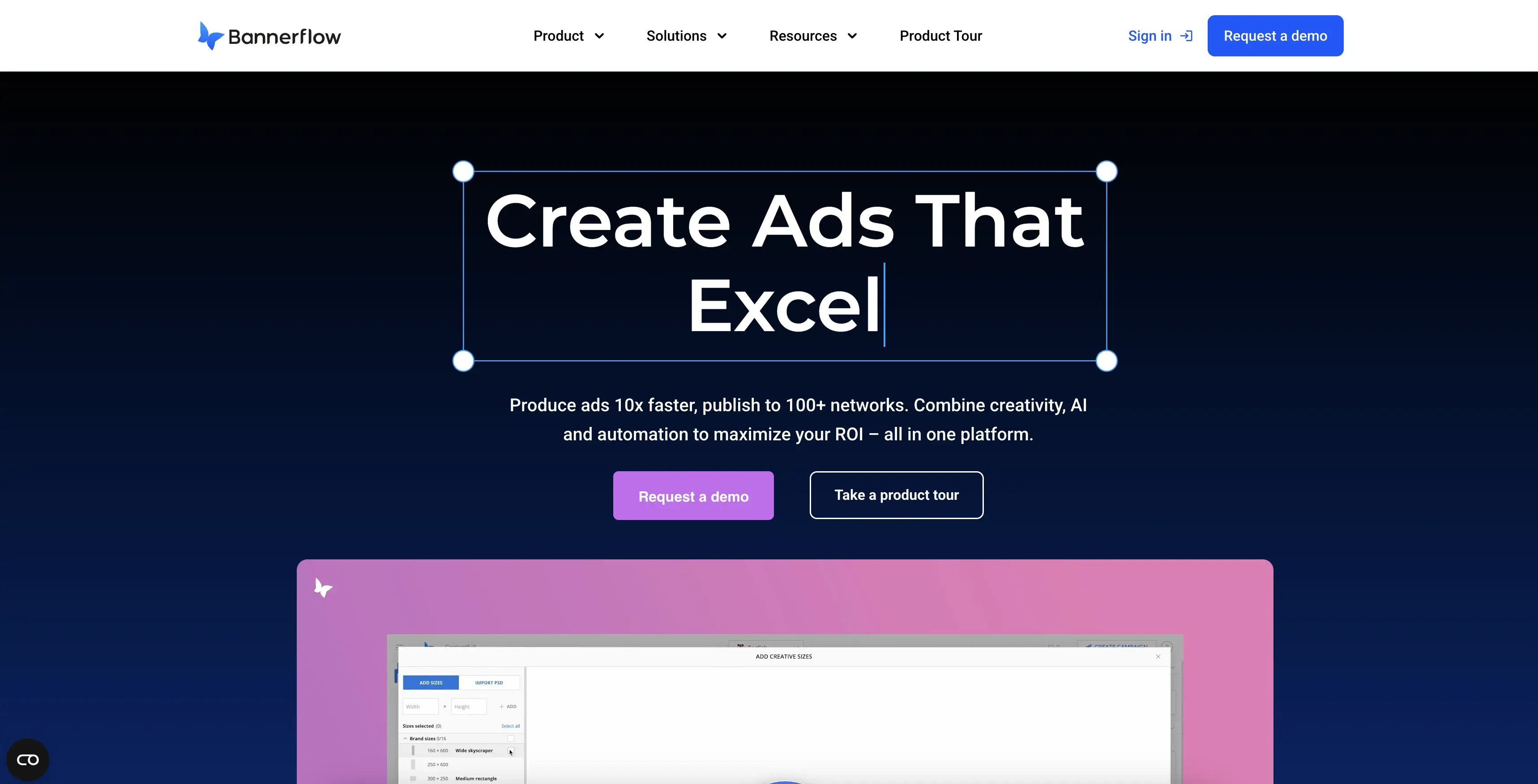
Best fit when: creative production must continue into ad publishing, scheduling, live updates, and creative reporting
Bannerflow is organized around the lifecycle of digital advertising rather than asset generation alone. Teams create HTML5 and video ads, scale them across placements, connect feeds, localize campaigns, publish creatives, and update live executions from the same platform.
What makes it different: Bannerflow keeps production close to active campaign operations. That is useful when publishing and updating ads are part of the same brief, but it represents a broader advertising workflow than a production layer designed to supply assets to an existing stack.
Primary scope: creative studio, scaling and versioning, feeds, localization, collaboration, publishing, DCO support, and real-time creative data.
Pricing: Bannerflow publishes Grow, Pro, and Enterprise packages but provides a tailored estimate after a demo rather than a fixed public price. See Bannerflow pricing.
Selection signal: shortlist Bannerflow when the team is specifically replacing a fragmented display-production and publishing workflow—not simply looking for more ways to generate finished creative files.
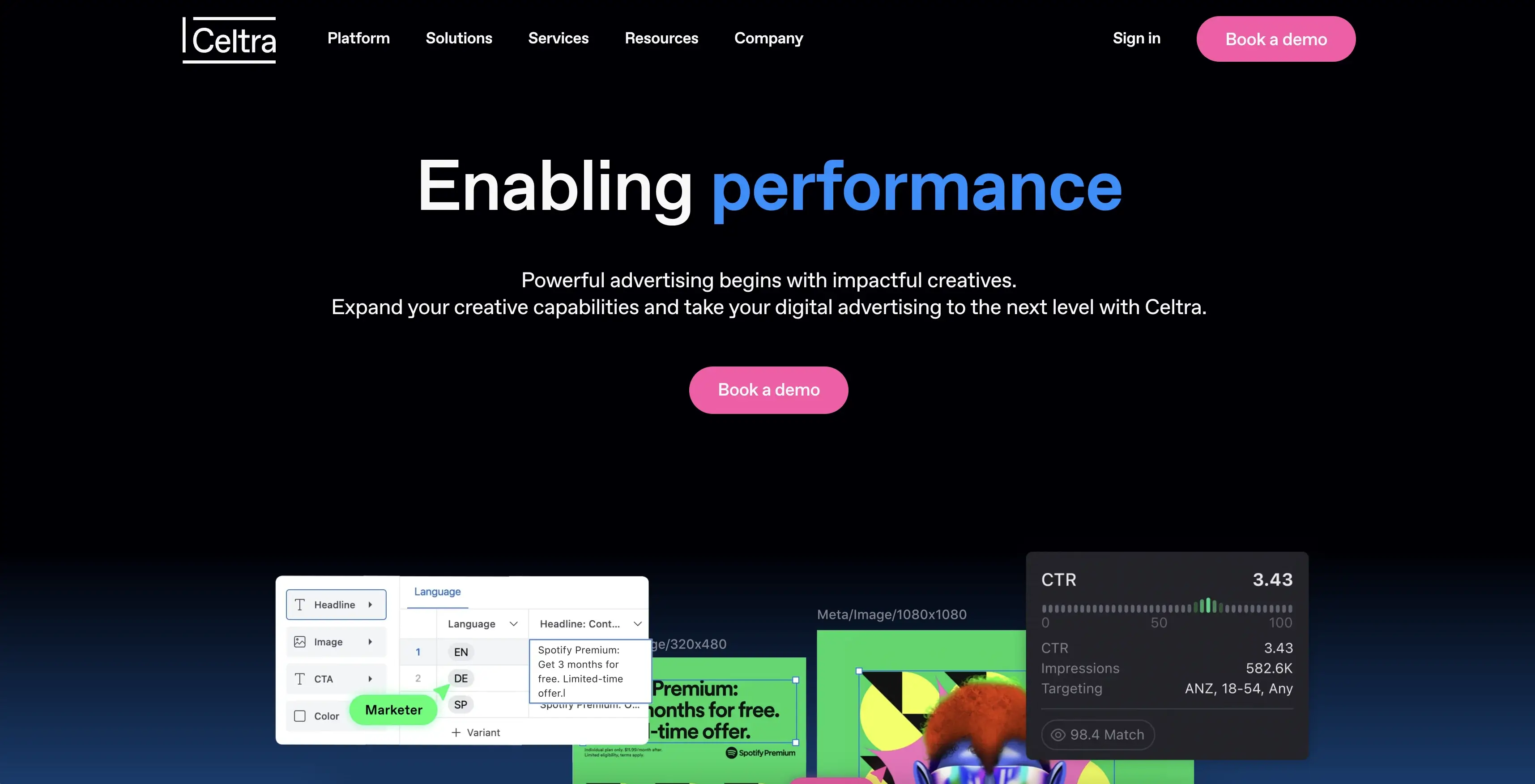
Best fit when: a global organization needs modular creative connected to governance, activation, and creative intelligence
Celtra treats creative automation as an enterprise advertising system. Its platform connects modular design, GenAI-assisted production, adaptation, review, approval, media activation, and creative insights across large campaign operations.
What makes it different: Celtra’s scope extends beyond generating campaign assets. It is designed to connect production with activation and performance feedback across enterprise teams. Buyers should therefore evaluate the operating model and implementation scope, not compare it with a production-only tool feature by feature.
Primary scope: modular creative systems, enterprise governance, GenAI-assisted production, multi-format and multi-market adaptation, activation, and creative intelligence.
Pricing: Celtra uses custom pricing based on the selected solution, team and production scale, ad serving, and add-ons. See Celtra pricing.
Selection signal: shortlist Celtra when modular enterprise advertising is the project. If the immediate problem is producing controlled assets for tools the team already uses, its broader scope may not be the deciding requirement.
Best fit when: campaign adaptation, localization, review, asset management, and delivery must share one governed environment
Storyteq places creative automation inside a wider content-marketing and asset-management workflow. Teams convert source designs into dynamic templates, produce localized adaptations in batches, review outputs, and organize the resulting assets.
What makes it different: Storyteq is not centered only on the generation event. The surrounding content operation, localization, approvals, delivery, metadata, and asset access.
Primary scope: dynamic templates, batch adaptation, localization, static, video, HTML5 and print outputs, review, delivery, and asset management.
Pricing: Storyteq lists both Professional and Enterprise as price on application. Its commercial model uses a one-time implementation charge and an annual license fee based on the selected setup and broad user tiers. See Storyteq pricing.
Selection signal: shortlist Storyteq when the creative-production project is also a content-operations or asset-governance project. For a more focused production layer, compare how much of that surrounding system the team actually needs.
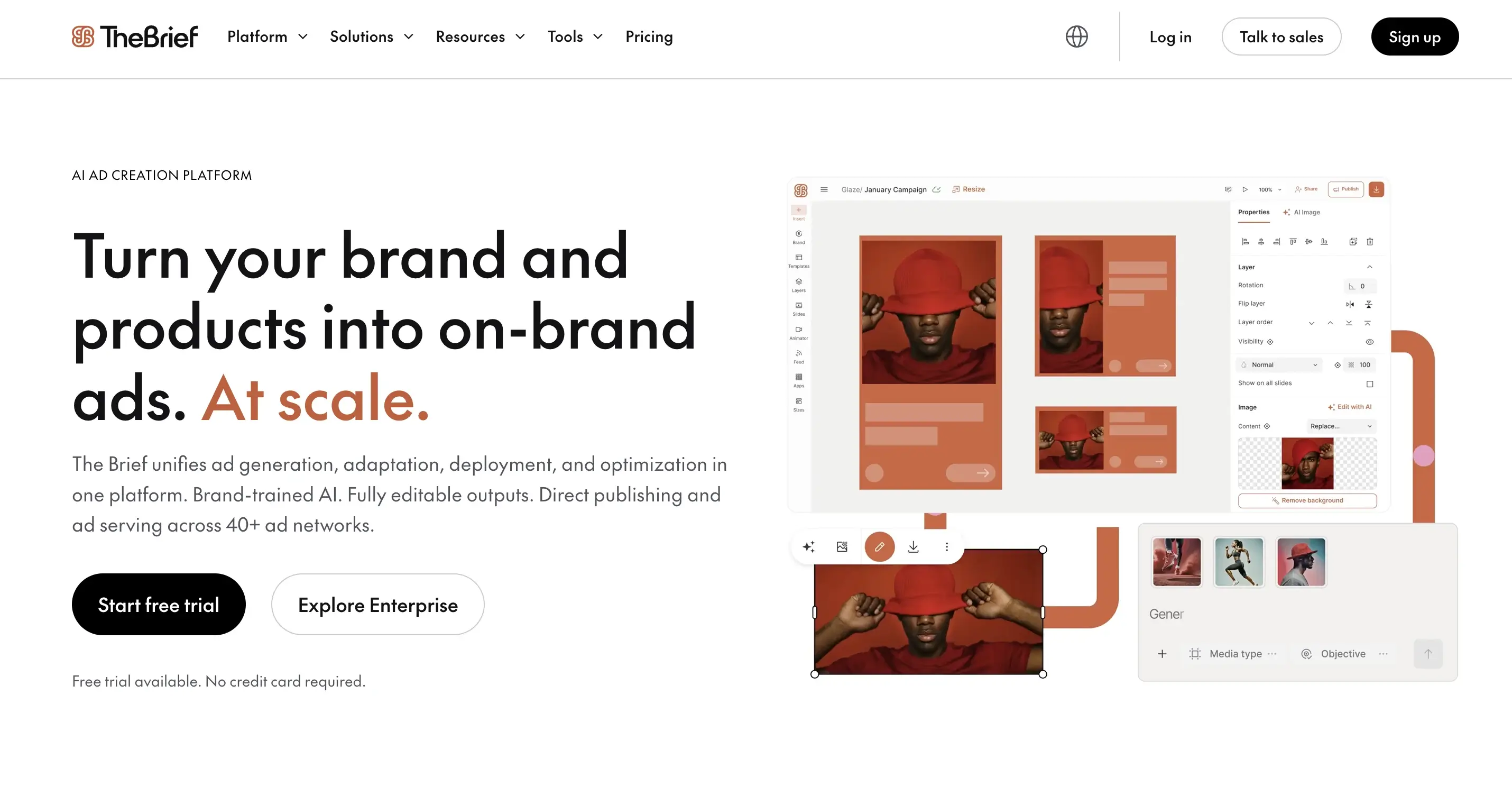
Best fit when: the workflow begins with prompts, templates, or hands-on ad design inside a self-serve editor
The Brief, combines an ad-design editor with prompt-based creation, AI image generation, resizing, animation, feed-driven variations, collaboration, and Zapier workflows.
What makes it different: The Brief begins earlier in the creative process than a data-led production engine. It is designed for users who want to create or remix the ad concept inside the product, then apply automation to resize, vary, and deliver it.
Primary scope: prompt-to-design, editable templates, AI image and copy tools, banner resizing, feed ads, animation, translation, collaboration, and ad-serving features.
Pricing: The Brief’s annually billed plans include Pro at $29/month, Ultra at $79/month, and Team at $49/seat/month. Enterprise uses custom, usage-based pricing. A seven-day trial is available without a card. See The Brief pricing.
Selection signal: shortlist The Brief when editor-led creation and common ad-production automation belong in one self-serve workspace. If approved Designs and structured inputs already exist, compare its generation routes with a dedicated production platform.
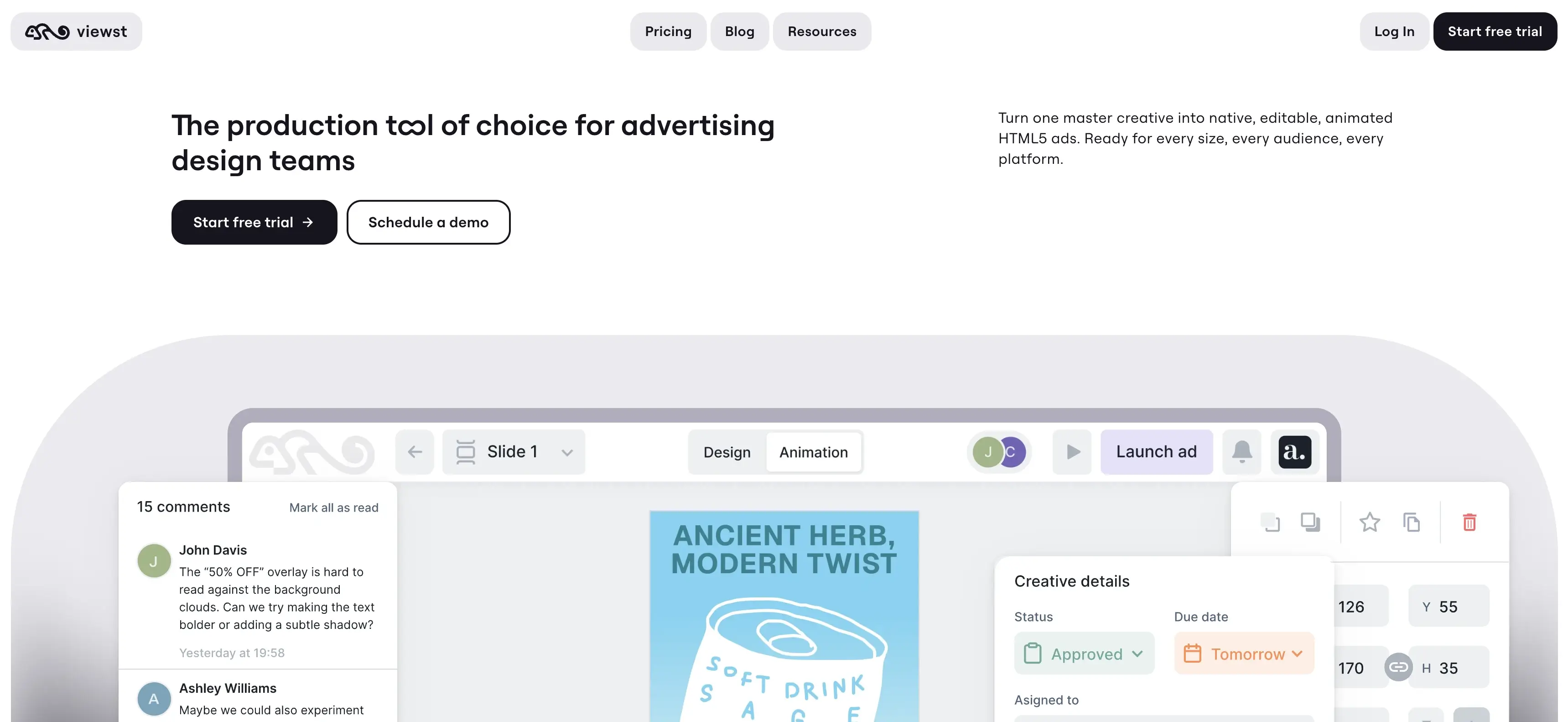
Best fit when: the required output is primarily an editable, animated HTML5 banner set across many display sizes
Viewst focuses on display-ad production and native, editable HTML5 output. Teams can start from a master banner, imported design, or flat source asset, adapt it across sizes, animate layers, collaborate on reviews, and export files optimized for ad networks.
What makes it different: Viewst’s proposition is narrower and more format-specific than a broad creative-production platform. Its AI Production Studio concentrates on banner generation, smart resizing, reconstructing editable designs from flat assets, and animation.
Primary scope: HTML5 banners, AI-assisted resizing and animation, editable design reconstruction, multi-size campaigns, variable and bulk generation, collaboration, approvals, and display-ad exports.
Pricing: Viewst’s annually billed plans start at $110/user/month for Standard, followed by Plus at $210 and Premium at $400. Enterprise uses custom pricing. A 14-day trial is available without a credit card. See Viewst pricing.
Selection signal: shortlist Viewst when HTML5 display production is the central requirement. If the workflow must also cover broader image, video, dynamic-image, API, or print use cases, compare that required output mix directly.
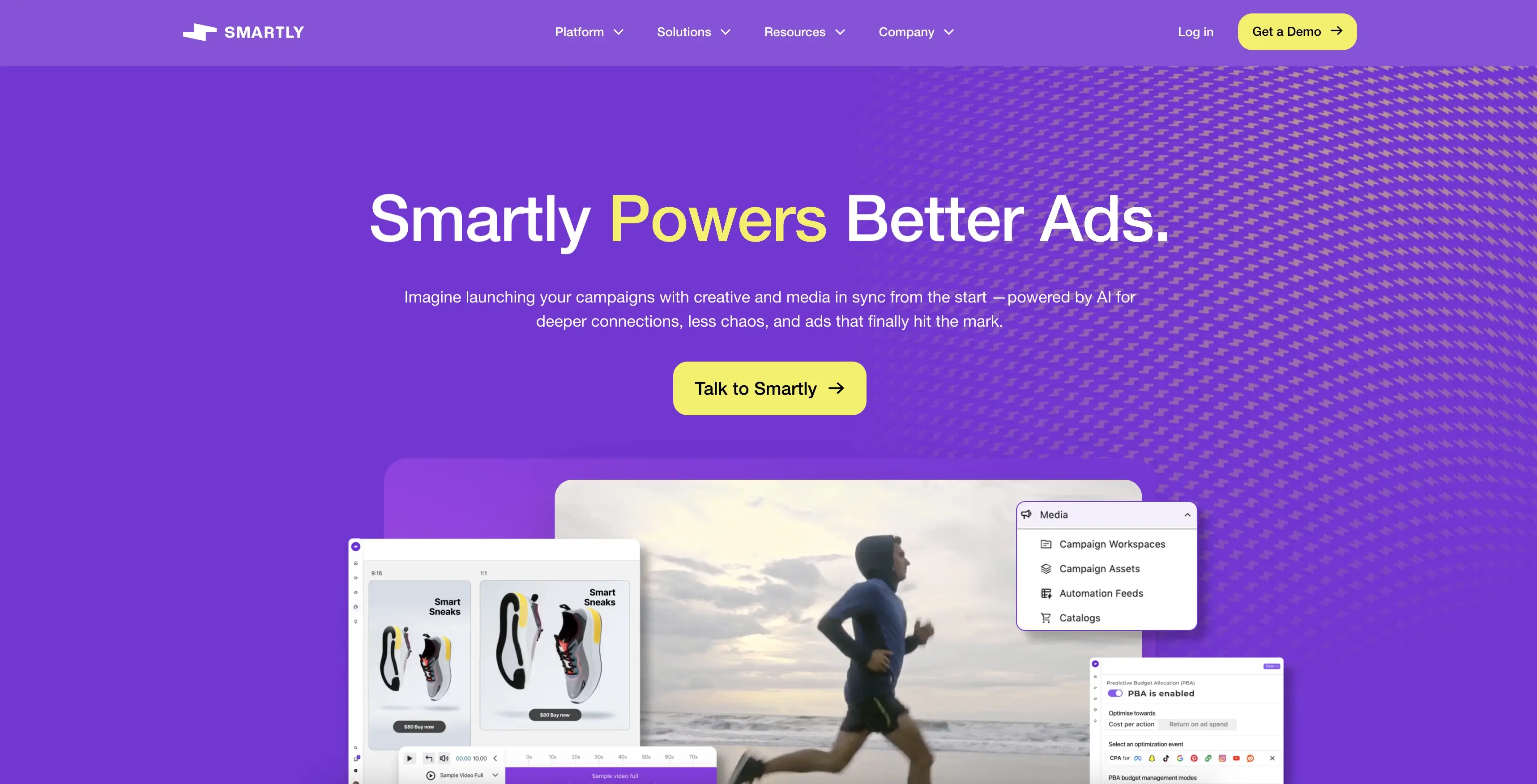
Best fit when: the buying decision covers creative production, trafficking, media management, and performance intelligence together
Smartly positions creative production as one suite inside a broader AI advertising platform. Its creative capabilities include templates, AI-assisted image, video, and text editing, personalization, predictive insights, DCO, and trafficking across social, display, and connected TV.
What makes it different: Smartly is the furthest option in this list from a standalone creative-production layer. Its value proposition depends on connecting creative and media operations, so it should be evaluated as an advertising-platform decision rather than as a direct file-generation replacement.
Primary scope: omnichannel creative production, personalization, DCO, trafficking, media management, and performance intelligence.
Pricing: Smartly’s current product pages do not display a public rate card and direct buyers to request a demo. Request a Smartly demo.
Selection signal: shortlist Smartly when media execution is explicitly in scope. If media already runs elsewhere and the bottleneck is asset production, its integrated media layer is not the problem being solved.
A polished demo can hide the edge cases that decide whether a platform works in production. Give every shortlisted vendor the same real campaign:
Measure setup time, production time, first-pass QA rate, exception handling, and the work still required outside the platform. The best result is not the largest batch. It is the most reliable end-to-end workflow.
For teams that need flexible, structured asset production without integrated media buying, Abyssale is our recommendation. Bannerflow should enter the shortlist when production must continue into live digital-ad operations; Celtra when the project is an enterprise modular advertising system; Storyteq when localization and asset governance belong in the same content operation; The Brief when creation begins in a prompt- and editor-led workspace; Viewst when HTML5 display banners are the central output; and Smartly when media management is explicitly part of the buying decision.
A creative automation platform uses reusable designs, rules, data, and software workflows to create or adapt visual assets at scale. It typically automates repetitive tasks such as resizing, localization, product variation, copy changes, format adaptation, and export. For a deeper explanation, read what creative automation is and how it works.
No. Generative AI creates or edits content from instructions, while creative automation produces controlled variations from predefined designs, rules, and data. Modern platforms can combine both: AI creates source material, and automation places it into governed multi-format production workflows.
Not by itself. Creative intelligence analyzes assets or performance to explain what may be working. Creative automation produces and adapts the assets. Some platforms include both capabilities, but analytics alone does not make a product a creative automation platform.
Not necessarily. Production-first tools such as Abyssale create assets for use in other systems. Advertising platforms such as Smartly connect creative automation with media management, while platforms such as Bannerflow and Celtra include activation or publishing workflows. Confirm where production ends and media execution begins before choosing.
Abyssale, The Brief, and Viewst publish self-serve prices. Abyssale starts at $45 per seat per month, The Brief at $29 per month with annual billing, and Viewst at $110 per user per month with annual billing. Bannerflow, Celtra, and Storyteq use quote-based pricing, while Smartly’s current product pages direct buyers to request a demo rather than displaying a public rate card. Pricing was checked on July 23, 2026 and should be verified again before purchase.
Creative automation is useful for marketing teams, agencies, ecommerce businesses, global brands, franchises, and developers that repeatedly produce variations across products, formats, languages, locations, audiences, or channels. It is less useful for one-off work where every asset needs a completely different art direction.
Explore our guides and tutorials to unlock the full potential of Abyssale's spreadsheet feature for scaled content production.