

3 advantages of using HTML5 for your banner ads
HTML5 has revolutionized the way we build the internet and the elements that make it up. Discover 3 advantages of HTML5 for your banner ads.

Historically, the HTML5 format has been inextricably tied to the digital display advertising ecosystem. As the industry moved away from static imagery toward interactive, rich-media formats, the ecosystem matured around the technical requirements of ad serving and distribution.
In the early stages of creative automation, the primary challenges were distribution-related: ensuring files met ad-network specifications, managing click tags, and maintaining small file weights for rapid loading.
However, as the demand for hyper-localization and personalization grows, the problem fundamentally changes. For the modern enterprise, HTML5 is no longer just a banner format; it is a complex, structured data output.
When volume and variation increase, the bottleneck is no longer how to publish the file, but how to generate thousands of brand-compliant versions of it.
The traditional model of HTML5 automation is "publishing-centric." In this environment, HTML5 creatives are managed primarily through ad servers and Creative Management Platforms (CMPs). The workflow is campaign-based, where a design is created, previewed, and then pushed directly to a display network.
Ownership in this model typically resides within media or ad ops teams. The tools are designed to optimize the connection between the creative and the media buy. While highly effective for managing the lifecycle of a digital display campaign, this model assumes that the "creative" is a static artifact that needs to be distributed, rather than a dynamic layout that needs to be programmatically generated at scale.
Organizations evaluating their technology stack during this transition often find themselves comparing display-centric vs production-centric tools to identify where their true operational bottleneck lies.
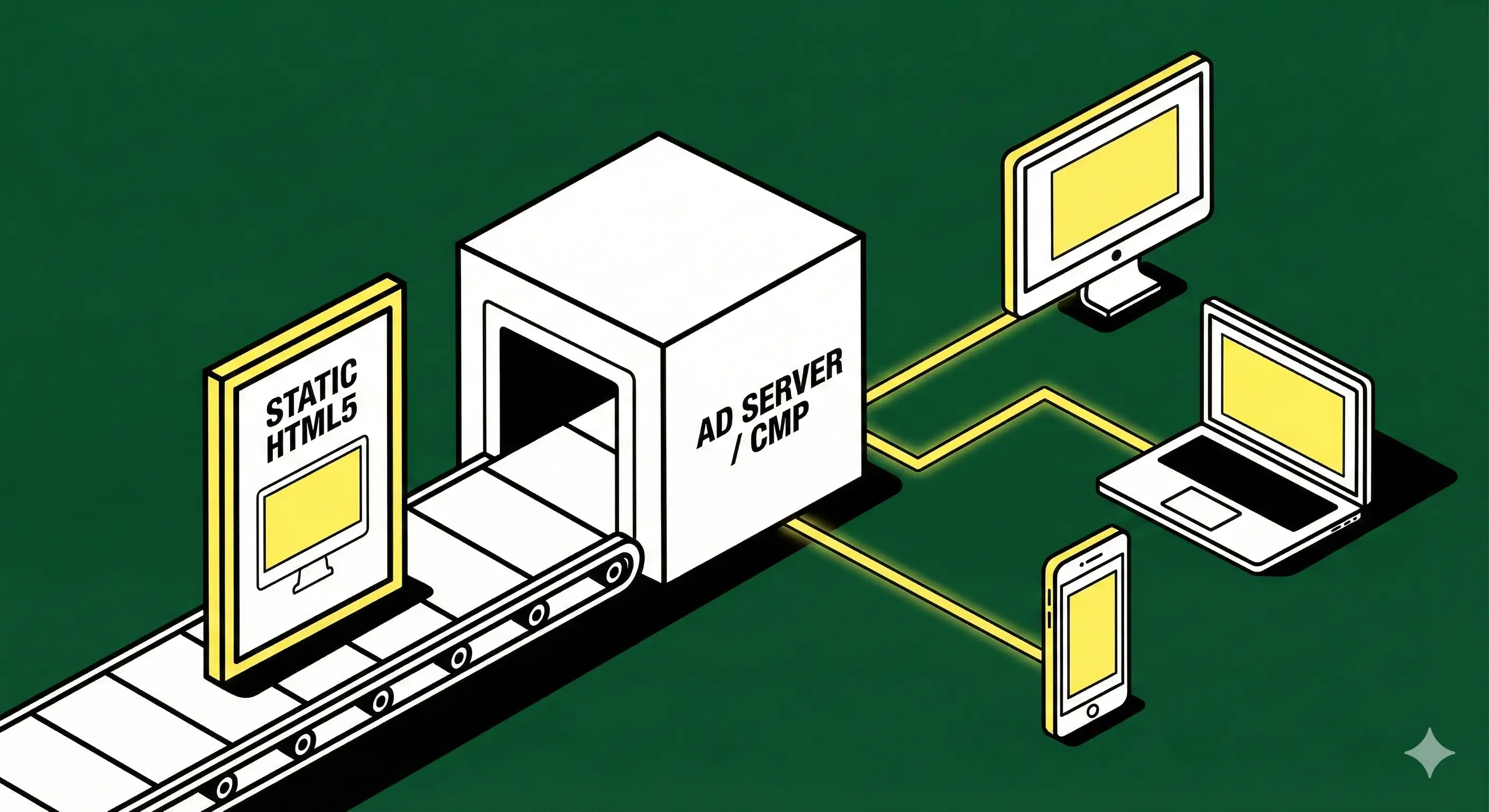
Organizations reach a critical threshold when the volume of HTML5 variants moves from hundreds to thousands. At this scale, the traditional manual or semi-automated resizing process becomes an operational liability.
The pressure of scaling stems from three specific vectors:
In these scenarios, publishing is a solved problem. Ad servers can handle the distribution of millions of files. The bottleneck is the generation > the process of creating those thousands of unique, localized, and technically perfect HTML5 files without manual intervention.
At scale, HTML5 creatives must be treated as structured, rule-based layouts. The shift toward a generation-centric model requires a focus on the underlying logic of the creative rather than the individual file.
Key operational requirements for HTML5 generation include:
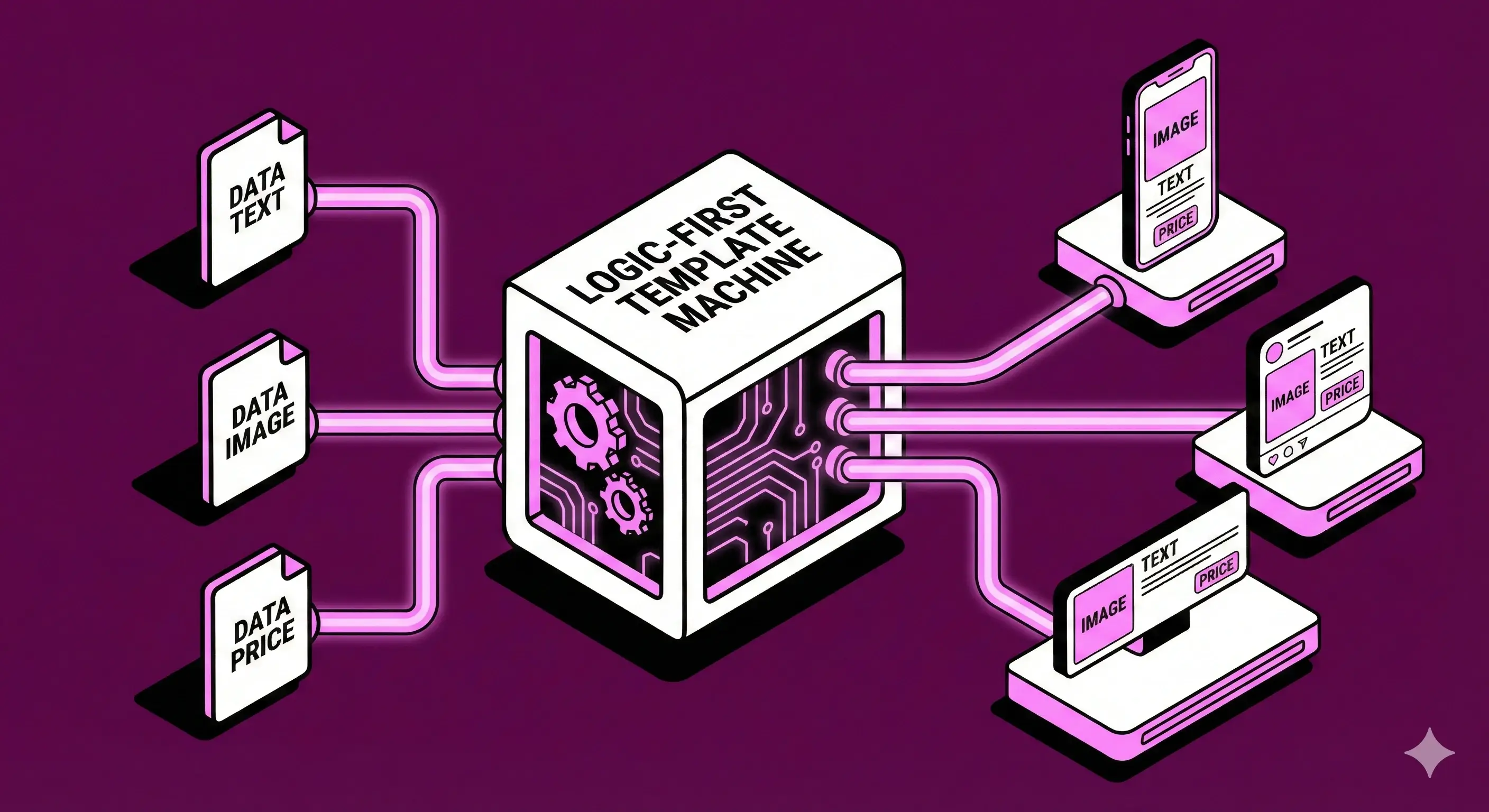
A common pattern observed in high-volume organizations is the transition from campaign-specific files to reusable HTML5 logic templates. In this paradigm, HTML5 is no longer a "project" to be finished; it is an "output" of a production system.
This production logic decouples the design from the distribution. By treating the creative as a set of rules (a template) and a set of data (text, images, prices), organizations can programmatically generate every necessary version of an ad.
The shift moves the ownership from media teams focused on ad networks to Creative Operations teams focused on production efficiency.
This transition allows HTML5 to be treated as a core creative production capability, rather than a byproduct of a specific media buy.
When enterprises evaluate systems to solve the HTML5 generation challenge, they typically prioritize selection criteria that emphasize scalability and programmatic control. Common requirements include:
When assessing the broader landscape of enterprise creative automation platforms, the distinction between a publishing engine and a generation engine becomes the primary factor in long-term operational success.
Systems like Abyssale are frequently cited as examples of this category, designed specifically to address the generation and adaptation of HTML5 at a scale that exceeds the capabilities of traditional publishing tools.
Why does HTML5 become difficult at scale?
HTML5 is technically more complex than static imagery because it involves code, animation, and responsive behavior. At scale, manual QA and resizing become impossible, making the "logic" of the layout the primary point of failure.
Is HTML5 automation mainly a publishing problem?
While publishing is a necessary step, the real challenge at enterprise scale is the generation of variants. Most ad servers can publish files easily, but they are not designed to programmatically adapt thousands of different layouts to varying content and sizes.
How do enterprises handle HTML5 variation without manual resizing?
Enterprises utilize logic-based generation engines. These systems use pre-defined constraints to tell each element how to move or resize based on the content or the container, allowing for thousands of "perfect" variants to be generated automatically from one master template.
The evolution of HTML5 automation reflects a broader shift in the marketing landscape. HTML5 is no longer just a banner format. At scale, it becomes a core creative production capability.
Organizations that recognize the distinction between publishing and generation are better positioned to handle the demands of hyper-localization and high-frequency content.
By moving from a campaign-centric to a production-centric model, enterprises transform their HTML5 workflow into a scalable, predictable, and logic-driven layer of their creative operations.
Explore our guides and tutorials to unlock the full potential of Abyssale's spreadsheet feature for scaled content production.

.webp)
%2520(17).webp)

